
WVDCR Release Search Scope
The official WVDCR Offender Search gateway offers distinct routes for jail offenders and prison offenders. That split reflects West Virginia's custody structure. WVDCR operates the ten regional jails as well as prisons and correctional centers. A person booked on a county charge usually belongs in the regional-jail search first. A person serving a state prison sentence belongs in the prison search. Daily Incarcerations is a current admission and incarceration product, not a list of people released that day.
Custody ownership matters more than the county line. A sheriff may create the arrest or transport record, while WVDCR holds the admission, movement, and release record for the regional jail. Prison records cover the sentenced population. The public prison search can also show an active DCR relationship after a person leaves the institution, such as parole or another form of supervision. It does not follow that every former prisoner will remain online after final discharge.
Use the WVDCR Offender Search
The official WVDCR prison offender search begins with first and last name and requires a CAPTCHA. An official municipal-court guide describes matching records as people in active DCR custody or supervision. It states that someone outside active DCR custody produces the red message, “No results found with specified criteria.” The wording makes the tool useful for present DCR status but weak as a stand-alone historical release certificate.
- Choose the prison search for a state prisoner. Use the separate regional-jail offender search for a county-charge jail stay.
- Enter the first and last name, complete the CAPTCHA, and run the search. Try exact spelling and known variants when a name does not match.
- Open the detail page for a possible match. Compare the OID, location, case context, and other identifiers instead of relying on a name alone.
- Copy each label exactly and record the date checked. A projected date, custody location, or supervision clue answers a different question from an actual physical release.
A match can support a finding that WVDCR still exercises authority. A no-result requires a wider check. Search VINE for a custody event, review the sentencing court record, contact Parole Services if parole is shown, and request the final release record from WVDCR when the actual movement must be established.
Note: The Daily Incarcerations page tracks admissions and current custody, so it should never be treated as a WVDCR release feed.
Read WVDCR Release Fields Carefully
No current official source reviewed for this project proves a standard discharged-person profile with a universal “Released” or “Discharged” label. Nor does it guarantee an actual-release-date field for every former prisoner. The table below separates fields that can be useful from claims the public site does not support. Preserve the exact text on a live record and never upgrade a projected date into a completed event.
| Portal item | Safe reading |
|---|---|
| OID or identifier | Use it to distinguish people with similar names and to frame a focused records request. |
| Current location | Shows the listed WVDCR placement or status when retrieved, not the full custody history. |
| Projected release date | A sentence calculation that can change; it is not proof of physical release. |
| Supervision clue | May explain why someone remains searchable after leaving a secure facility. |
| No results message | Does not reveal whether the cause is discharge, spelling, population choice, or a visibility limit. |
| Actual release or discharge | Verify through the final movement record, court order, VINE event, or discharge record. |
Internal files are broader. WVDCR Policy 151.00 calls for legal and booking documents, earlier incarceration links, case material, and release records. Policy 142.00 treats offender records as confidential in nature and limits disclosure. The agency's duty to keep an internal file does not create a promise that the same material remains public through OIS.
WVDCR Release Date Meanings
Official court filings have quoted a “projected release date” from the WVDCR portal. WVDCR Policy 151.06 uses a more precise term: minimum discharge or final release date. Policy 454.10 defines that date as the scheduled sentence release assuming continuous incarceration and no loss of good time. It is a forecast from sentence computation. It does not confirm that processing occurred at the gate.
- Parole eligibility date
- The point when Board consideration may begin, not a hearing date or parole grant.
- Projected or minimum discharge date
- A computed date that can be revised for credit, discipline, or legal changes.
- Actual release date and time
- The completed physical movement recorded by the custodian.
- Maximum parole discharge date
- The outside end of the parole term, not the day the person left prison.
- Discharge certificate
- A document proving the end addressed by that certificate.
These labels should stay separate in notes and requests. A Board decision may precede transfer. A transfer may lead to another custodian. A sentence date can change before release. The most reliable account identifies each event, its agency, and its source rather than forcing all dates into one “release date” field.
West Virginia WVDCR Release Routes
West Virginia law provides several paths out of secure WVDCR custody. Discretionary parole is conditional release approved by the West Virginia Parole Board and supervised by WVDCR Parole Services. Mandatory post-release supervision moves part of a sentence into supervised release under W. Va. Code §15A-4-17. Conditional release under §15A-4-17a can cover the final portion before minimum expiration for an eligible felony inmate. The Nonviolent Offense Parole Program has separate rules.
End-of-sentence discharge reaches the computed minimum or final release point without continued DCR parole, though another legal duty may remain. A court can also order release through probation, time served, a changed conviction, home confinement, or another order. These categories are not synonyms. Each has its own authority and may leave a different record trail.
Conditional-release and program policies begin orientation and out-processing before the target date. They require OIS release entries and a maximum parole-discharge date. A detainer can redirect the movement to another custodian. Thus, WVDCR release can mean delivery to another agency rather than community release. The statewide Facility Directory helps identify the operator and the proper release-record route.
Note: WVDCR policy supports release transportation and document processing, but no verified statewide gate-money amount or travel entitlement was found.
WVDCR Good Time and Release
The Legislature's official good-time statute shows the source used to calculate many West Virginia discharge dates.
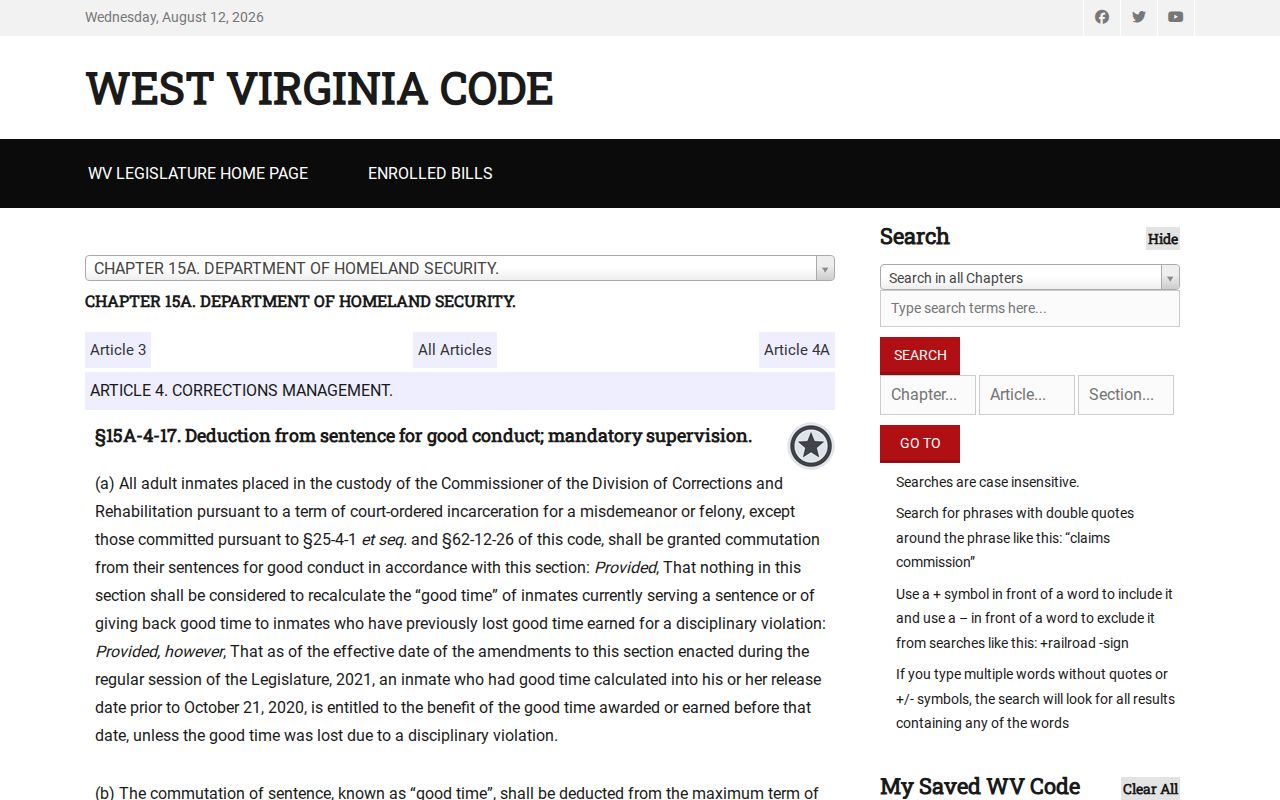
The statute ties earned credit to the sentence calculation while also defining exclusions, forfeiture, restoration, and mandatory supervision. Eligible adults generally earn one day of good time for each day physically incarcerated, including qualifying presentence jail credit. No credit accrues for parole, bond, or other time outside incarceration. Life sentences receive no good time.
Day-for-day credit does not prove that each person serves half of the announced term. Consecutive terms, the credited start date, excluded categories, discipline, amended orders, and supervision rules can alter the result. No general West Virginia “85 percent rule” was verified. Claims about the neighboring Commonwealth of Virginia do not apply here.
WVDCR Release Trends by Category
WVDCR annual reports show stable totals across two years and a modest decline in the next, but the legal categories moved in different directions. They also contain a method change. Fiscal 2023 and 2024 excluded prison-sentenced people housed temporarily in jail locations, while the fiscal 2025 table includes them. A raw year-to-year comparison must carry that caution.
| Fiscal year | Total | Paroled | Mandatory release or supervision | Discharged |
|---|---|---|---|---|
| FY2023 | 2,882 | 1,772 | 51 | 501 |
| FY2024 | 2,884 | 1,794 | 58 | 469 |
| FY2025 | 2,808 | 1,748 | 97 | 459 |
Totals fell by 76 from FY2024 to FY2025, about 2.6 percent. Mandatory release or supervision rose from 51 to 97 across the three reports, while discharge fell from 501 to 459. These changes do not show that release became easier or harder. The categories have distinct meanings, and the inclusion method changed.
The FY2025 report also counted 2,926 Parole Services clients on June 30, 2025, including 1,124 out-of-state cases. That supervised total includes several groups and must not be labeled simply as West Virginia parolees. Physical release, active supervision, and final discharge remain separate measures.
WVDCR Release or County Record
West Virginia does not fit a simple state-prison-versus-county-jail split. WVDCR runs regional jails, while counties create arrest, court, and transport records. A person held before trial may have a WVDCR regional-jail movement record and a county court order. A sentenced prisoner uses the prison path. Federal and immigration custody require their own systems.
| Last custody | First public route | Best confirming record |
|---|---|---|
| WVDCR prison | Prison offender search | WVDCR final movement, release, or discharge record |
| WVDCR regional jail | Regional-jail offender search | WVDCR jail movement plus the county court order |
| County-created case record | Circuit or magistrate court portal | Signed order from the proper clerk |
| Federal or ICE custody | BOP or ICE locator | Record from the federal custodian |
The County Directory routes to the local case and agency context. A blank sheriff roster does not prove release because many counties send adults to a state-run regional jail. Likewise, a WVDCR exit to BOP, ICE, or another state is a transfer until the receiving side confirms what occurred.
Request WVDCR Release Records
West Virginia FOIA gives access to nonexempt public records through §29B-1-3. A request must reach the custodian and identify the desired information with reasonable detail. Within five days, excluding weekends and legal holidays, the custodian must provide copies, set reasonable inspection terms, or issue a written denial. This is a response deadline, not a promise that a large production will finish in five days. Existing electronic records must be supplied electronically when requested in that form. Actual reproduction costs may be charged, but that section does not authorize search, retrieval, or labor fees.
WVDCR Policy 108.01 identifies the Commissioner as custodian. Send a focused written request to Commissioner, West Virginia Division of Corrections and Rehabilitation, 1409 Greenbrier Street, Charleston, WV 25311. The main number is 304-558-2036. No current dedicated FOIA email or web form was verified.
- Identify the adult by full name, aliases, OID if known, facility, case number, and a useful date range.
- Ask for existing records that show the final movement, actual release date and type, release order, public final time sheet, and discharge record if one exists.
- Request electronic copies and all reasonably segregable nonexempt parts. Ask the agency to cite the legal ground for each withholding.
- Keep WVDCR, court, Parole Board, and sheriff requests separate. Each custodian should receive the request for records it created or maintains.
Exemptions in §29B-1-4 can protect personal, medical, investigative, and security material. Policy 142.00 can also require redaction of case, health, victim, supervision-needs, or operational details. A narrow request for an existing final release record is more precise than a demand for the entire offender file.
The West Virginia Court Record Access page shows the two statewide court routes that can supply the judicial side of a WVDCR release.
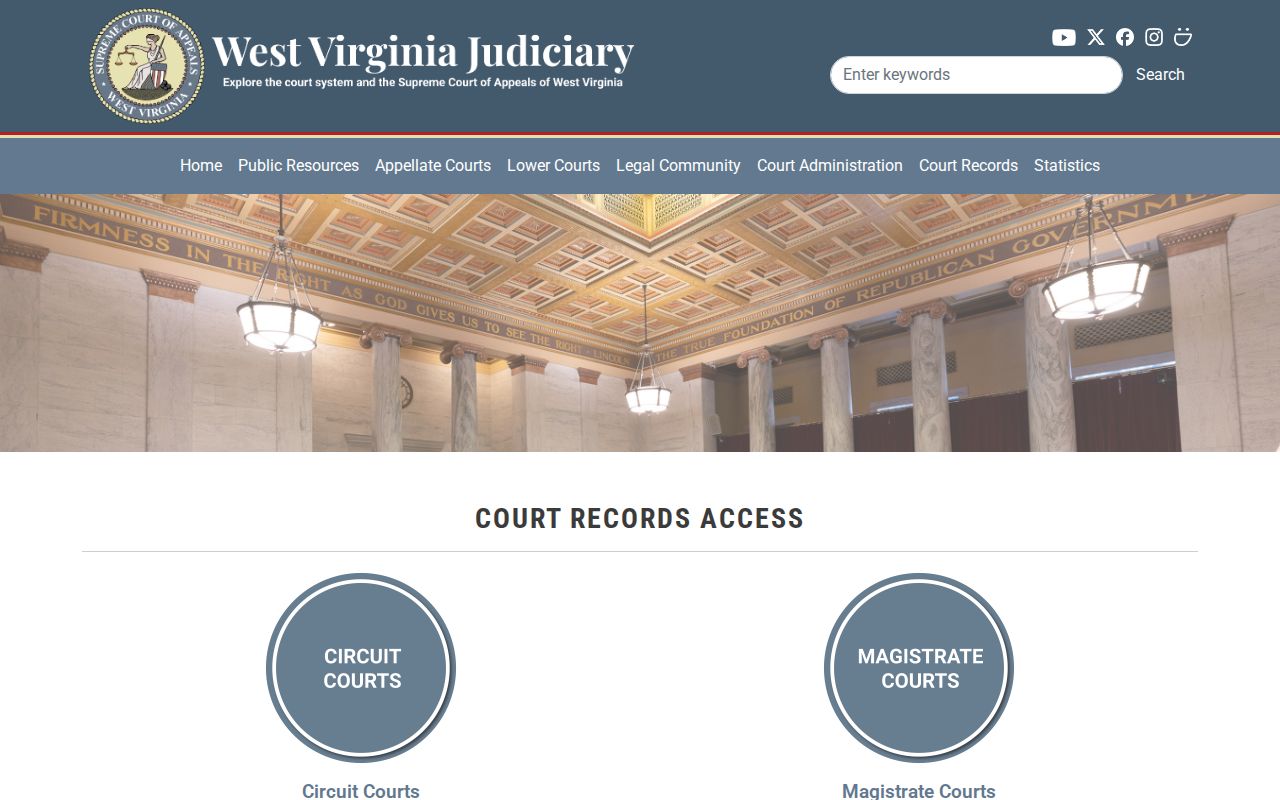
WVPASS covers circuit cases, while the Magistrate Case Record Search covers magistrate matters. Neither is a live custody registry, but a signed order can explain why a WVDCR movement occurred.
A useful response can be smaller than the full legal file. The final movement entry may establish the time, type, and destination category. A release checklist can show that institutional processing was complete. The final public time sheet can distinguish a projected date from the credit actually applied. A discharge certificate may address the later end of DCR control. Asking for each existing record by name helps the custodian separate releasable administrative facts from confidential health, victim, classification, or security material.
Agency ownership still controls. WVDCR is the right custodian for its prison or regional-jail movement. The court clerk holds the signed judicial order. The Parole Board maintains its hearing record, while Parole Services handles field-supervision records. A sheriff remains the source for sheriff-created arrest or transport material. Separate, tailored requests reduce delay and make a written denial easier to assess.
Public online visibility and agency retention are different questions. Policy 151.00 requires WVDCR staff to maintain legal, booking, classification, case-management, and release documentation, yet Policy 142.00 describes offender records as confidential in nature and controls disclosure. An internal file can therefore survive after a name disappears from the public WVDCR offender search. The practical response to an empty search is a focused records request, not a claim that no record exists. Ask for the existing final movement and release documents, accept lawful redactions, and request the precise legal basis for any withheld part. If the answer identifies a transfer, repeat the verification with the receiving custodian. That sequence produces a stronger release history than a screenshot of a no-result message.
Note: When dates conflict, preserve every source label and ask which agency record documents the completed physical movement.