
Understanding West Virginia Releases
A release is the end of one custody event, not always the end of correctional control. West Virginia uses state-run regional jails for most adult county bookings, and the West Virginia Division of Corrections and Rehabilitation, or WVDCR, also runs the prison system. That structure differs from states where each sheriff operates a full county jail. An arresting sheriff may hold the arrest or transport record while WVDCR holds the regional-jail admission, movement, and release record. The signed court order remains with the circuit or magistrate clerk.
Physical release may mean bond, time served, probation, parole, conditional release, mandatory supervision, final discharge, or transfer to another custodian. A person can leave a regional jail for a WVDCR intake site, federal custody, or ICE without entering the community. Likewise, a state prisoner can leave an institution yet remain subject to Parole Services. The precise release type and receiving authority matter more than the fact that a name vanished from one screen.
Important: Disappearance from a live roster does not establish community release, the date of release, or the end of supervision.
West Virginia Release Routes
West Virginia law and WVDCR policy use distinct labels for different exits. Discretionary parole is conditional release approved by the West Virginia Parole Board and supervised by WVDCR Parole Services. Mandatory post-release supervision moves part of a sentence from secure custody into monitored release. Conditional release can place an eligible person on a supervised plan for the final portion before minimum expiration. The Nonviolent Offense Parole Program has its own rules. Final discharge reaches the computed sentence end without continuing WVDCR parole, though a separate order or hold can still apply.
| Release route | What changes | Best record source |
|---|---|---|
| Bond, time served, or court order | Regional-jail custody ends under a judicial or administrative event | WVDCR jail record and the county court file |
| Parole | Institutional custody ends, but supervised status continues | WVDCR record, Parole Board record, and Parole Services |
| Conditional or mandatory release | Part of the term continues under supervision | WVDCR time sheet, release record, and supervision record |
| Final discharge | The correctional term addressed by the discharge ends | Discharge certificate or final-discharge record |
| Transfer or detainer | One agency releases the person to another custodian | Movement record from both sending and receiving agencies |
A detainer is a request or authority for another agency to take custody. WVDCR conditional-release policy states that a person subject to a detainer is released to that detainer unless the filing authority gives the required consent. That is why the destination or transfer indicator belongs beside the date and type in any sound West Virginia release record review.
Note: A parole grant, transfer date, physical exit, and final discharge can be four different events with four different records.
West Virginia Release Record Fields
A complete inquiry asks for existing records, not a new legal conclusion. WVDCR Policy 151.00 identifies release-related material that can exist in an offender legal file, including a court release order, release checklist, discharge certificate, and final-discharge record. A final time sheet may show how sentence credit and the minimum or final release date were computed. County sheriffs may separately hold arrest, incident, or transport material. Court clerks hold the signed orders that explain bond, dismissal, probation, sentence changes, or release authority.
| Field or document | What it can establish |
|---|---|
| Full name, aliases, and OID | Identity link to the correct WVDCR record |
| Facility and movement history | Which custodian held the person and whether an exit was a transfer |
| Actual release date and time | The completed physical movement, when recorded |
| Release or discharge type | Parole, court release, conditional release, final discharge, or another event |
| Destination or transfer indicator | Community exit, supervision, or delivery to another authority |
| Authorizing order | The court, Board, sentence, or policy basis for the movement |
| Final time sheet | The sentence computation and credits reflected in the existing record |
| Discharge certificate | The correctional end documented by that certificate |
Labels must stay attached to their source. A projected release date is a sentence calculation, not proof that release happened. A parole eligibility date marks when consideration can begin, not a hearing grant. A maximum parole discharge date marks an outside supervision date. Only an actual release entry or completed movement record speaks to the physical event, and even that event may lead into other custody.
Requesting West Virginia Release Records
West Virginia’s Freedom of Information Act gives every person a right to inspect or copy nonexempt public records held by a public body. The request must go to the correct custodian and describe the existing information with reasonable detail. Under W. Va. Code §29B-1-3, the office has up to five days, excluding weekends and legal holidays, to provide copies, arrange inspection, or issue a written denial with reasons. This is a response deadline, not a promise that a large production will be finished within five days.
- Identify the adult by full name, aliases, date of birth, OID if known, case number, facility, and a practical date range.
- Send WVDCR a written request for its existing admission, movement, release, time-sheet, checklist, or discharge records. Direct it to the Commissioner at 1409 Greenbrier Street, Charleston, WV 25311.
- Ask the county sheriff only for sheriff-created arrest, incident, or transport records. Ask the proper court clerk for the signed order.
- Request electronic copies when the records exist electronically. Ask for reasonably segregable, nonexempt portions and the exact basis for each withheld part.
- Compare each returned date by label and source. If they conflict, ask which existing record marks completed physical movement.
The statute permits actual reproduction costs but does not authorize search, retrieval, or labor charges under that section. No current WVDCR public-records web form or dedicated FOIA email was verified. The supported route is a written request to the Commissioner; the agency’s main telephone is 304-558-2036. WVDCR Policy 142.00 may require redaction of confidential case, health, victim, supervision-needs, or security material. Policy 151.00 shows that internal files can be broader than the public website, but internal retention does not guarantee public disclosure or online access.
Request focus: Ask for the final movement, actual release date and type, destination category, authorizing order, public final time sheet, and discharge record.
Note: A narrow request for existing final records is easier to route than a demand for an entire offender file.
West Virginia Release Records Law
Public access has limits. W. Va. Code §29B-1-4 preserves exemptions for some private or medical facts, confidential records, law-enforcement material, and correctional details that could aid escape or injury. A custodian may redact protected content while releasing segregable parts. Juvenile and sealed records follow narrower access rules. No numeric public-search retention period for a fully discharged WVDCR record was verified, so the presence of an internal file must not be confused with permanent display on OIS.
The West Virginia good-time and supervision statute also explains why release and discharge are not synonyms. It provides the framework for good time, sentence calculation, and forms of mandatory supervision. The statute image below shows the official legislative source rather than a commercial summary.
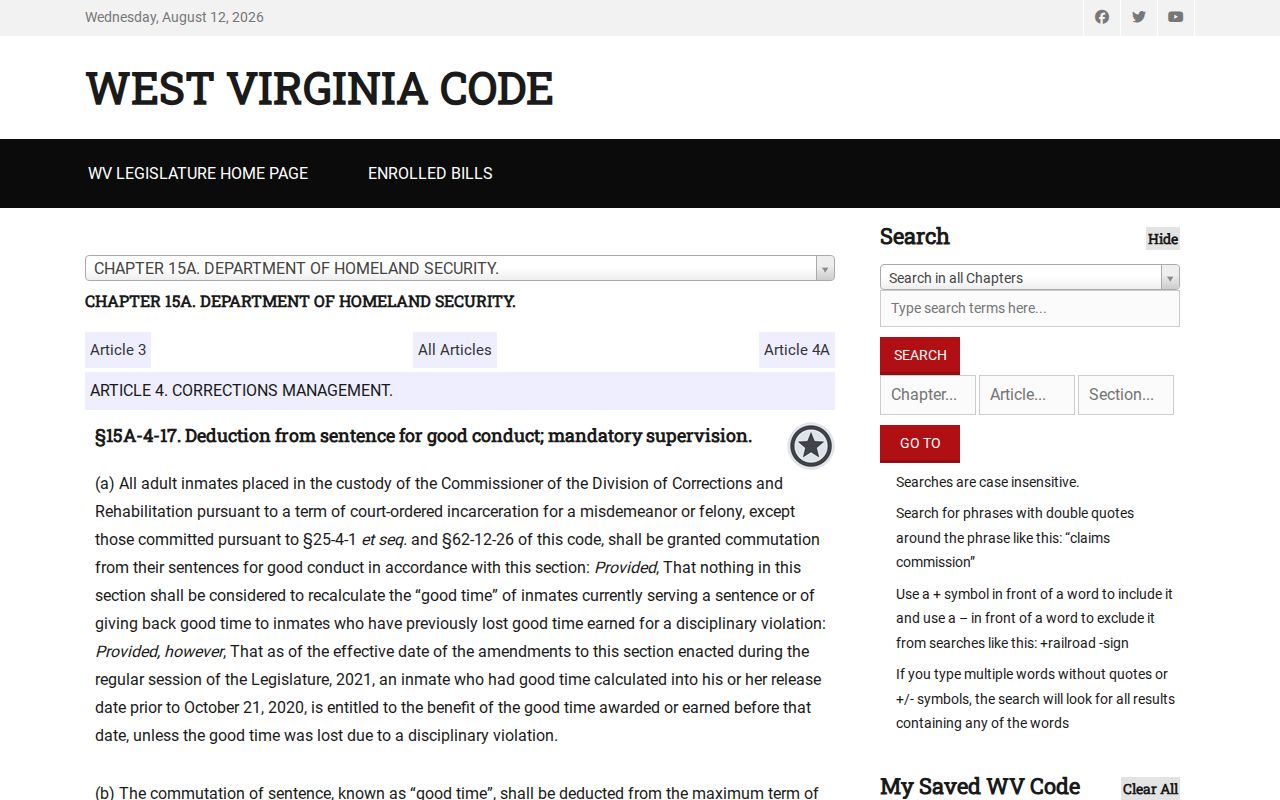
The provisions connect sentence credit to custody status, while the completed release record remains the better proof that a planned movement took place.
West Virginia Release Trends
WVDCR annual reports show stable totals with a changing mix. The agency reported 2,882 releases in fiscal year 2023, 2,884 in fiscal year 2024, and 2,808 in fiscal year 2025. Parole accounted for 1,772, 1,794, and 1,748 of those annual totals. Mandatory release or supervision rose from 51 to 58 and then 97, while the discharge category declined from 501 to 469 and then 459. Conditional release moved from 119 to 90 and then 44. These figures describe agency categories; they do not say that one route is easier or harder.
The comparison has a method break. WVDCR said its fiscal year 2023 and 2024 tables excluded prison-sentenced people temporarily housed in jail locations, while the fiscal year 2025 table included them. The supervised count also includes more than state parole alone. On June 30, 2025, Parole Services reported 1,124 out-of-state cases within its 2,926-client total. A statewide total cannot identify one person’s status, and category changes must be read with the report year and method attached.
Search West Virginia Released Inmates
The search path starts with custody ownership. WVDCR’s gateway separates regional-jail and prison populations. Daily Incarcerations is an admissions and current-incarceration product, not a daily release list. The prison search accepts first and last name and requires a CAPTCHA. Official instructions state that a person outside active DCR custody produces “No results found with specified criteria.” That message does not state when custody ended, why it ended, or whether the person moved elsewhere.
| Search field or choice | How to use it | Limit |
|---|---|---|
| Jail or prison population | Choose regional jail for a county booking and prison for a state sentence | The two routes cover different custody populations |
| First name | Enter the person’s first name in the prison form | A name alone does not prove identity |
| Last name | Enter the person’s last name and check spelling | A no-result has several possible causes |
| CAPTCHA | Complete the live verification before submitting | It is required by the official prison search sequence |
| OID on a result | Use the identifier to corroborate the correct record | Record only what the live detail actually provides |
- Choose the regional-jail search for a county booking or the prison search for a state sentence. Do not switch the populations without noting why.
- Search the exact first and last name, complete the CAPTCHA, and use an OID or other matching facts when available.
- Transcribe the live labels, facility, dates, and retrieval date. Treat a projected date as a projection.
- Check VINE for a participating agency’s status change and the proper court system for the order behind the event.
- When OIS returns no match, request the final release record instead of treating the blank result as a discharge certificate.
A person released to parole or another active DCR status may still be searchable. A fully discharged person may not be. No current official source guarantees a permanent historical class, a universal “Released” or “Discharged” label, or an actual-release-date field for every former prisoner. The dedicated WVDCR offender search route handles the state-system distinctions in more depth.
- OID
- WVDCR offender identifier used to distinguish people with similar names.
- Projected release date
- A sentence-based estimate that can change, not proof of completed release.
- Discharge
- The end addressed by the final-discharge record or certificate.
- Detainer
- Authority or a request that can send a person to another custodian at release.
Current and former status require different evidence. The following comparison keeps a live locator from being mistaken for a historical release archive.
- Still in a regional jail
- Use the WVDCR jail search and read the current facility label.
- Released from a regional jail
- Use the final WVDCR movement record, court order, and VINE status change.
- Active prison or supervision status
- Use the WVDCR prison search and copy its exact current labels.
- Fully discharged from WVDCR
- Request the discharge certificate or final-discharge record because OIS may show no result.
- Released from federal custody
- Use the BOP result, while checking whether another custodian or supervision still applies.
County-Based West Virginia Release Records
West Virginia’s fifty-five counties do not each maintain a parallel full jail and release feed. Ordinary adult bookings repeatedly route to ten WVDCR regional jails, often outside the county where the arrest and court case began. One agency can therefore hold the arrest or transport record, another the custody movement, and a third the release-authorizing order. Absence from a county sheriff roster cannot be read as release because the person may have been held at a regional facility from the start.
The West Virginia County Directory supplies the county case route, while the statewide facility navigation identifies the physical custodian. Search both sides when the county of arrest differs from the jail’s location. WVDCR is the best source for a regional-jail admission, movement, or release record it maintains. The county circuit or magistrate clerk supplies the court context. A sheriff request should stay limited to records created by that sheriff.
Why is a released person missing from the county list? The county may never have run the custody database. A WVDCR regional jail may hold the operative record, or the exit may have been a transfer instead of a community release.
Note: County boundaries organize charges and courts, while WVDCR regional facilities often organize the actual adult custody record.
West Virginia Release Alerts and Custody
West Virginia VINE covers all ten regional jails and WVDCR prisons. It supports anonymous checks by phone, internet, and app, with notification options through app, telephone, email, and text. Search a specific person by exact name or an offered identifier, then compare the agency, facility, and available identifying facts. Read the live wording as written. A reported release event shows a change from the participating agency, but it does not rule out a detainer, transfer, parole, probation, mandatory supervision, or federal control.
The VINELink West Virginia selector shown below begins the specific-person and notification route.
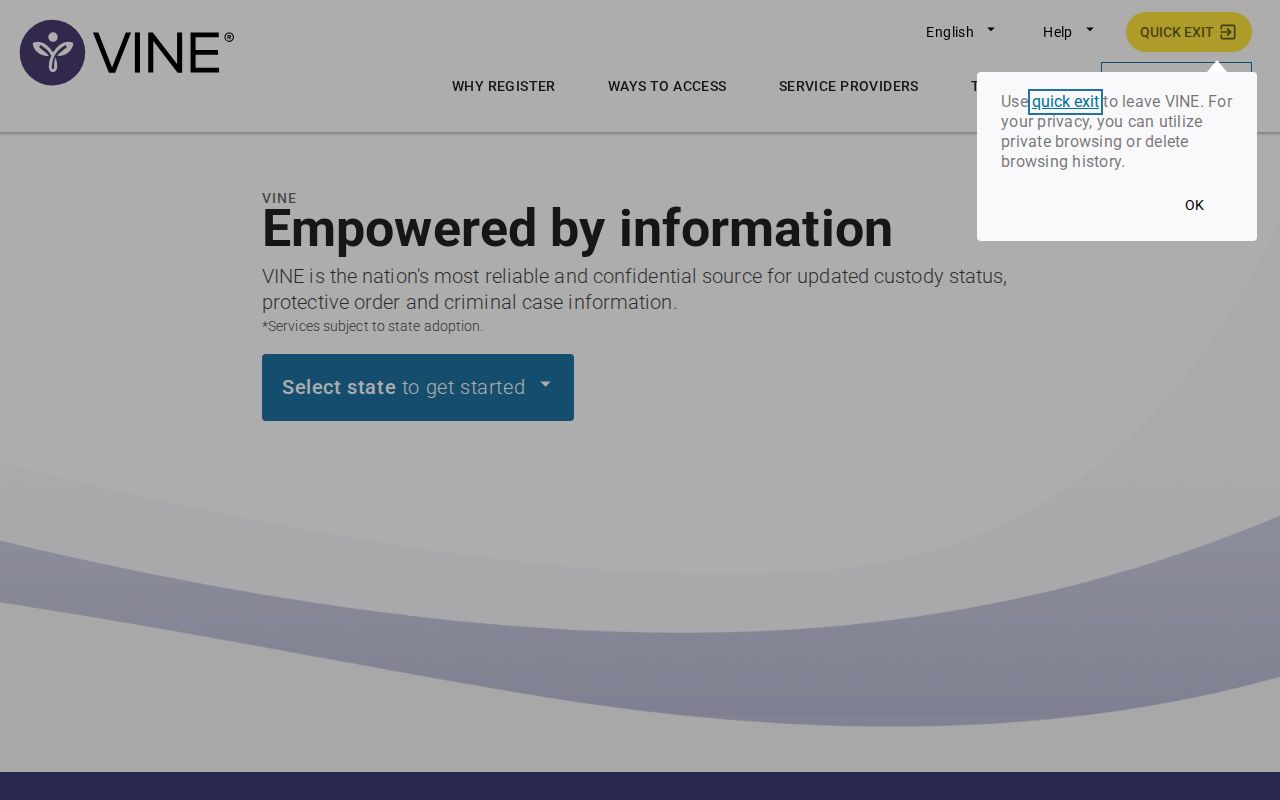
Once the correct record is open, use only the channels and confirmation prompts offered in the live interface. The state telephone route is 1-866-WV4-VINE, or 1-866-984-8463.
VINE has an intentional timing limit. WVDCR delays a transfer notice until the person arrives at the receiving facility. The gap protects transport safety but also means that disappearance from one view can precede the next update. Municipal holding rooms, federal sites, ICE, and out-of-state placements are not proven to have universal West Virginia VINE coverage.
Federal Release Searches in West Virginia
Federal custody requires the Bureau of Prisons locator, not WVDCR. The system covers federal custody records from 1982 forward and allows a search by BOP, DCDC, FBI, or INS number. A name search can add age, race, and sex. Results may show name, register number, age, race, sex, release date, and location. The federal route applies to West Virginia institutions such as FCI Beckley, FCI Gilmer, the Hazelton complex, FCI McDowell, FPC Alderson, and FPC Morgantown.
The official BOP Inmate Locator image provides the correct federal search form.
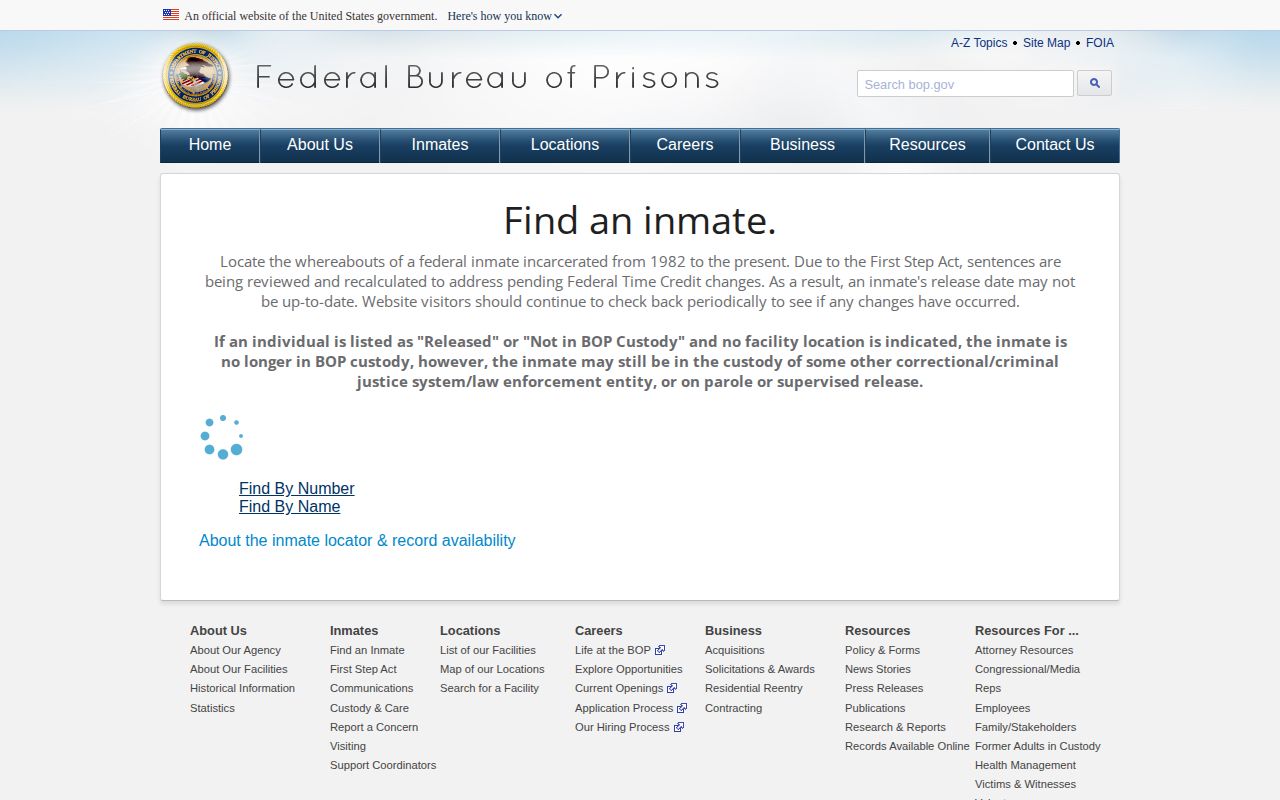
A “Released” or “Not in BOP Custody” result means only that BOP custody ended. A past date without a facility is a BOP release date; a future date is projected and can change. Neither label excludes state custody, another law-enforcement hold, parole, or federal supervised release.
ICE uses its own Online Detainee Locator System. The preferred search uses a nine-digit A-number and country of birth; a shorter A-number needs leading zeroes. A biographical search uses exact first and last name plus country of birth, with date of birth available. The locator concerns adult ICE custody and is not a permanent archive of released people. If a regional jail or BOP entry ends in an ICE transfer, verify both the sending and receiving systems.
West Virginia Court Release Records
West Virginia has two statewide trial-court search routes. WVPASS covers circuit matters in all fifty-five counties, while the Magistrate Case Record Search covers magistrate matters statewide. A bond or early case event may sit in the magistrate system, then a felony sentence or amended order may appear in circuit court. Checking one portal cannot rule out a record in the other. Court entries can explain bond, dismissal, sentence, revocation, probation, or a changed order, but they are not live custody or supervision registries.
The Judiciary’s West Virginia Court Record Access screen links the two systems.
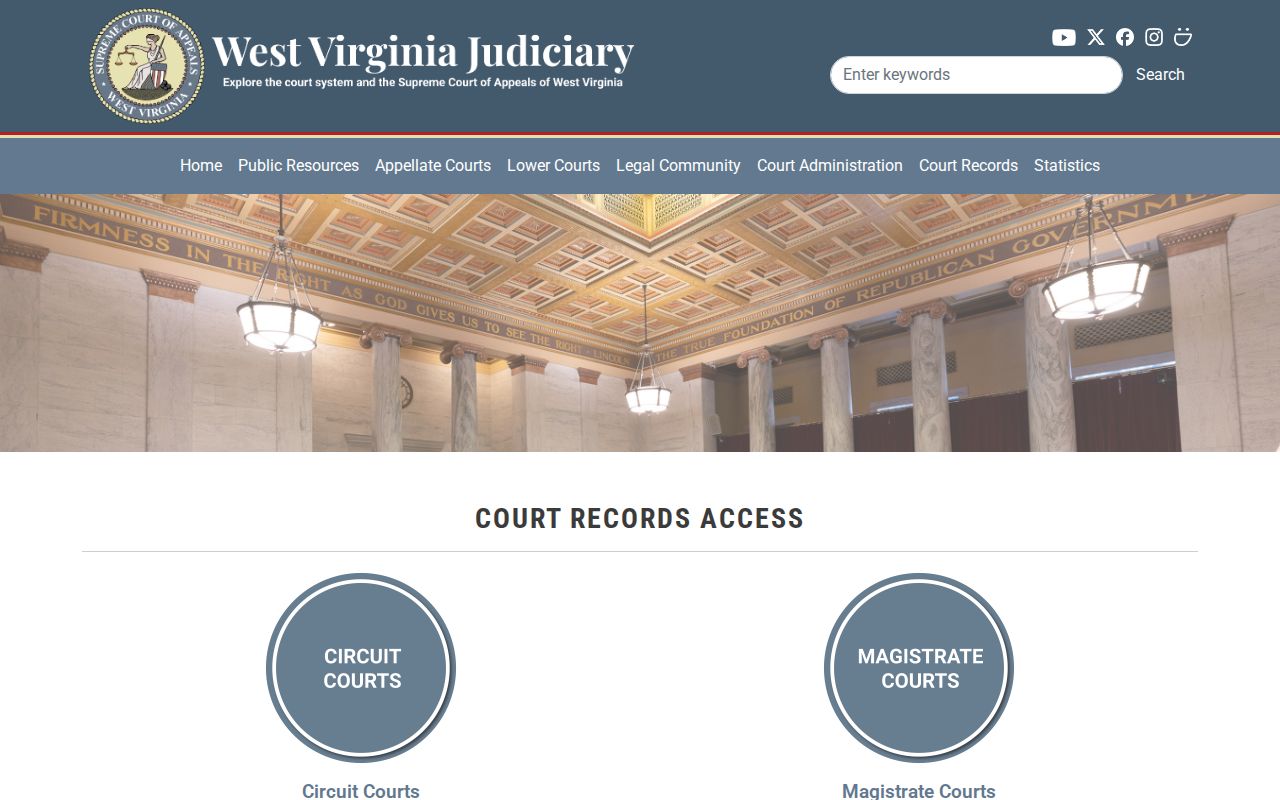
The split matters when a release-authorizing event and later sentence occupy different court levels. WVPASS launched March 10, 2025, with free registration and searching. Public circuit documents extend back to 1999, and standard downloads cost twenty-five cents per page plus a small card-processing fee. Sealed and juvenile files are excluded. Older or restricted material requires the proper clerk route.
When the court date differs from the WVDCR movement date, keep both. The judge may sign first, facility staff may process later, and VINE may update after the agency feed changes. The best final account names each event instead of choosing the earliest date.
West Virginia Booking-Photo Relief
West Virginia’s booking-photo rule is narrow and tied to the case outcome. W. Va. Code §62-1-6a generally limits law-enforcement social-media posting of a booking photo for an alleged minor offense unless an exception applies. Exceptions include a conviction, fugitive or imminent-threat circumstances, or a court order based on legitimate interest. The law does not make every booking image secret, and it does not make a photograph proof that someone remains in custody or has been released.
When an agency posted a booking image for a suspected offense, it must remove the image from its social-media page within fourteen days after a proper request and proof of a listed favorable outcome. Those outcomes include dismissal, no indictment, acquittal, reversal, vacatur, or another nullification. The statute’s agency definition excludes WVDCR and its subordinate organizations. No separate codified West Virginia ban on a commercial removal fee was located, and removal from one agency page does not erase copies elsewhere.
Release verification should come from the custody movement, court order, VINE event, or final record. A booking image is an arrest-era record. Its presence does not show current status, and its absence can reflect policy or a valid removal request rather than a release event.
Note: Preserve the image source, case outcome, and custody source as separate facts; none substitutes for the other two.