
West Virginia VINE Coverage
West Virginia activated Victim Information Notification Everyday, or VINE, in December 2002. The state expanded service in 2019 to all ten regional jails and enhanced coverage for WVDCR correctional facilities and prisons. The official WVDCR VINE page supports anonymous custody checks by telephone, internet, and app. Notification channels include app, phone, email, and text, subject to the choices shown in the live service.
This broad state-system reach does not prove universal coverage. The official material reviewed does not establish that every municipal holding room, federal institution, ICE placement, or out-of-state custodian participates. A person held on a county charge will often be in one of the state-run regional jails, but the agency and facility on the live record still matter. A state prison record belongs to the WVDCR prison side. Federal custody requires a different locator.
| Custody system | West Virginia VINE role | Needed fallback |
|---|---|---|
| Ten regional jails | Statewide participation documented | WVDCR jail search, court order, or facility confirmation |
| WVDCR prisons | Correctional-facility and prison coverage documented | WVDCR prison search and records request |
| Municipal or out-of-state placement | Universal participation not established | Contact the named custodian |
| Federal or ICE custody | Not established as VINE coverage | BOP Inmate Locator or ICE ODLS |
Search West Virginia VINELink
The live VINELink service starts with a state selection and a person search. Use the exact name or an identifier offered by the interface. Several people can share a name, so compare the listed agency, facility, and available demographic details. Never treat a name-only result as final identity confirmation.
The captured VINELink source shows the West Virginia selection and search interface used for a specific-person check.
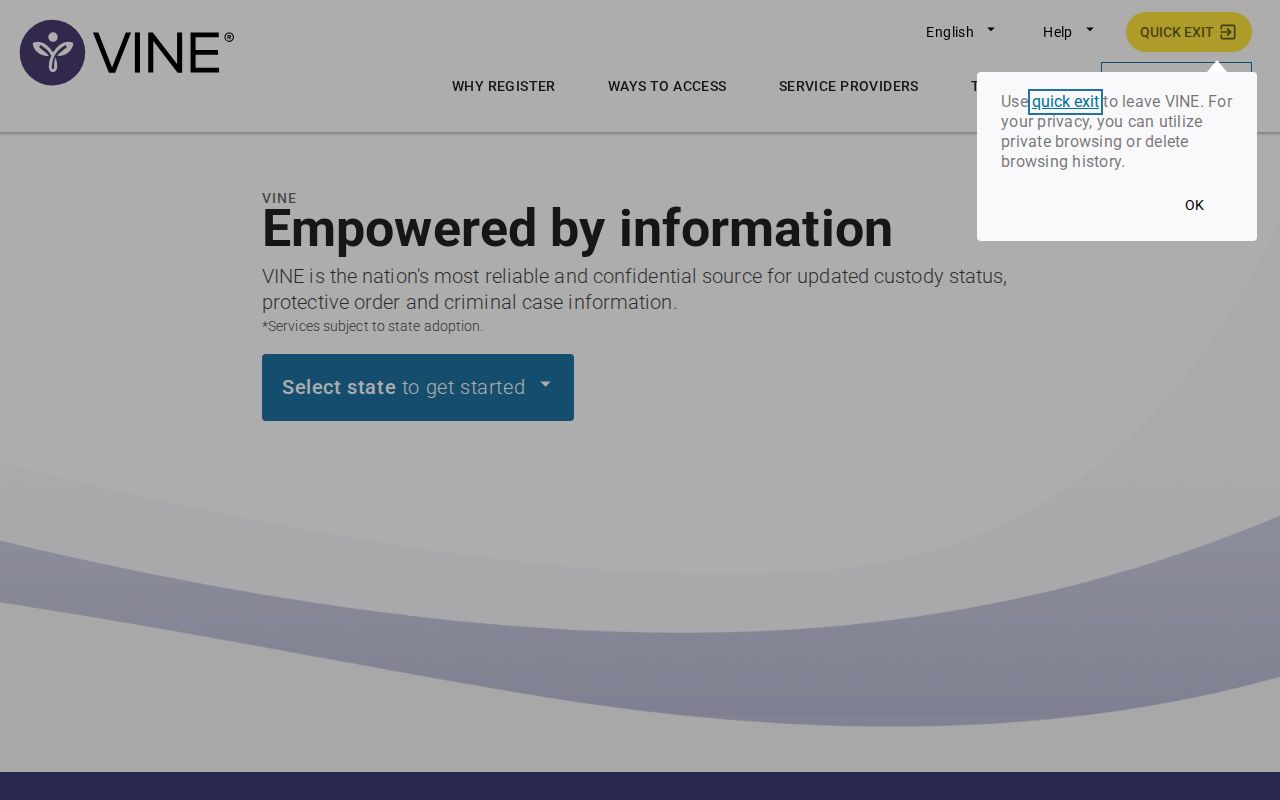
The interface is a starting point for reading the live record and selecting notification options, not proof that every custody system has reported the person.
- Open VINELink and choose West Virginia as the state.
- Enter the exact first and last name or use an offered identifier when one is known.
- Review each possible match. Compare the responsible agency, facility, and other available details.
- Open the correct record and copy the status in its own words. Note the date and time checked.
- If the person cannot be found, move to the correct WVDCR, court, federal, ICE, or agency route instead of declaring release.
The statewide County Directory helps connect an arrest county to its local record path. It does not override the facility named by VINELink.
West Virginia VINELink Release Fields
VINELink is designed to report a person's custody relationship with a participating agency. The exact fields and words can change, so the live record controls. Research supports using the custody status, agency or facility, identifier, and any offered custody-change information to distinguish possible matches. A scheduled date must not be rewritten as an actual event.
| Field | How to read it |
|---|---|
| Name and identifier | Identity clues that should be checked with the agency and other lawful details |
| Custody status | The participating agency's current reported wording, not a broad legal conclusion |
| Agency or facility | The system that supplied the record and the place tied to the current report |
| Custody-change event | A reported release, transfer, parole, discharge, escape, death, or other covered change |
| Date information | A scheduled or reported date whose label must be preserved |
Policy 457.08 identifies parole, discharge, court-ordered release, work-release transfer, escape, and death as changes that can generate notice. Those terms do not mean the same thing. “Release” from one agency can also be a transfer to another custodian. Confirm destination and legal status before describing the person as free from custody.
Note: Save the exact field label because scheduled release, actual release, parole, discharge, and transfer answer different questions.
Register West Virginia Release Alerts
Notification registration begins only after the correct person record has been opened. Select the notification option shown in the current VINELink interface, choose from its offered channels, and complete each confirmation prompt. WVDCR documents automatic phone notice and email registration. The 2019 expansion announcement also identifies app and text options. The current interface should control the available choice rather than an assumed fixed menu.
- Confirm the record belongs to the intended person and participating agency.
- Select notifications from that record, then choose one or more channels the live service offers.
- Enter the requested contact details carefully. Follow the current confirmation or security prompts.
- Complete registration and keep any confirmation supplied by the service.
- If a notice arrives, read the event wording and call the reporting agency when the destination or release type is unclear.
The research does not support promising a fixed PIN step for every channel. Prompts can differ by interface and delivery method. Registration should also be updated through the service when contact information changes. For telephone access, West Virginia lists 1-866-WV4-VINE, or 1-866-984-8463.
Important: Automated VINE registration does not replace every formal written victim-notice request that may apply through WVDCR or the Parole Board.
West Virginia VINE Transfer Delay
West Virginia's statewide system has an intentional transfer-notice delay. WVDCR explains that notice waits until the person arrives at the receiving facility for officer safety. Combined with participation by all ten regional jails, that rule creates a period when a person may have left one location but not yet produced the later transfer alert.
A roster disappearance during this interval is not proof of community release. The person may be moving to another regional jail, a prison intake point, or another lawful custodian. A later arrival notice can resolve that movement. Until then, compare the sending agency, the receiving record when available, and any court or transfer order.
This is especially important after a Parole Board grant from a regional jail. The Board FAQ says the person first transfers to a DCR facility for intake and fingerprinting, and families should allow seven to ten days for actual release. The grant, transfer, arrival, and gate release can all have different dates.
Note: A delayed transfer alert is a safety feature, so a short information gap should not be filled with an assumed release outcome.
Confirm West Virginia VINE Results
VINELink is an agency-notification system, not a permanent statewide release archive. A current record can help identify custody or report a change. A missing record can mean spelling trouble, the wrong state, a system outside participation, transfer timing, full discharge, or another data limit. It does not establish when or why custody ended.
For a WVDCR prison or regional-jail case, use the correct OIS population. The prison search and regional-jail search are separate. Daily Incarcerations is an admission and current-incarceration product, not a daily release list. When a completed release must be proved, obtain the court order, institutional release record, or discharge record from the agency that owns it.
For federal custody, use the BOP Inmate Locator. BOP results can state “Released” or “Not in BOP Custody,” but that only ends BOP custody and may leave another system or federal supervision in place. ICE ODLS is a current custody-location tool, not a lasting released-person archive. Neither system should be folded into West Virginia VINE coverage.
The West Virginia released inmates search sets out the full fallback chain across WVDCR, courts, VINE, BOP, ICE, and public records. That broader check is needed when the VINELink event does not identify the final destination.
West Virginia VINE Record Requests
A VINELink alert can be saved as a lead, but the originating agency's official record is the stronger source for a completed movement. Ask WVDCR for a regional-jail or prison release record that WVDCR maintains. Ask the court clerk for the signed order. Ask the Parole Board for a hearing record, and use Parole Services for the appropriate supervision route.
A focused West Virginia FOIA request should name the adult, OID if known, facility, date range, and the existing record sought. Useful terms may include actual release date and time, release or discharge type, transfer indicator, authorizing order, or discharge certificate. Ask for electronic delivery and segregable public portions. Confidential case, medical, victim, and security material may be withheld or redacted.
West Virginia law directs a records request to the custodian and requires reasonable specificity. The custodian must respond within a maximum of five days after receipt, excluding Saturdays, Sundays, and legal holidays, by producing records, arranging inspection, or giving a written denial with reasons. That period is a response deadline, not a promise that a large set will be fully copied at once. Electronic copies should be requested when the record exists in that form.
When sources show different dates, keep each label and retrieval date. A court can sign an order before facility processing ends. VINE can update after an agency feed changes. A transfer notice is delayed until arrival. Ask which existing record documents the completed physical movement rather than silently choosing the first date seen.
Can a VINE alert prove final discharge? No. The notice proves the event reported by the participating agency. Final discharge, a parole term, a court case, or custody under another agency may still need separate records.
West Virginia VINE Notice Scope
VINE supports anonymous checks, but registration and formal notice are separate concepts. WVDCR policy lists several reportable events, while other legal notice steps may require a written request to DCR and the Parole Board. Automated registration should not be represented as filing every notice request that a person may be entitled to make.
Each alert should be read as an agency event. A parole alert does not show that parole later ended. A work-release transfer is not final discharge. An escape or death notice carries a wholly different meaning from a release event. The sound record keeps the event label, reporting agency, time received, and any later confirmation.
If telephone or web access fails, the state VINE number provides another channel. A caller should still confirm identity and the exact facility before relying on a status. No notice service can remove the need to contact the originating agency when an alert is unclear or when another custodian may now hold the person.