
West Virginia Projected Versus Actual
WVDCR Policy 151.06 calls the core sentence calculation the minimum discharge or final release date. Policy 454.10 defines it as the scheduled date of sentence release if incarceration remains continuous and the person loses no good time. Federal court filings have also quoted the WVDCR portal's “projected release date.” Each term describes a forecast. None proves that staff completed a release or that a person entered the community.
An actual release date and time records a completed movement. The destination may be parole, mandatory supervision, another jail, BOP, ICE, or a different legal custodian. A maximum parole discharge date marks the outside end of parole. A parole eligibility date marks when Board review can begin. These dates often appear close to one another, but they measure different events.
Pretrial detention follows a different path. A person without a sentence has no minimum discharge date to compute. Bond, dismissal, time served, a plea, or another court order may end that stay. The regional-jail search and the circuit or magistrate case record provide the right context.
Find a West Virginia Projected Date
Start by deciding whether the person is in a WVDCR prison, a WVDCR regional jail, a federal institution, or another system. West Virginia's official gateway keeps prison and jail searches separate. Daily Incarcerations is not a projected-release tool. For a sentenced state prisoner, use the prison search and preserve the exact wording shown on the live detail record.
- Open the official WVDCR prison offender search. Enter first and last name, then complete the CAPTCHA.
- Compare identifiers on possible matches. Use an OID, case details, or a known location to avoid confusing people with similar names.
- Copy the date and its full label. Record the day checked because a later time sheet can replace the old calculation.
- Decide whether the label is projected release, minimum discharge, parole eligibility, maximum parole discharge, or final discharge.
- Compare it with the judgment and any amended court order. Ask WVDCR for the current time sheet when the public label is unclear.
A person who left a prison for active parole or another DCR status may remain searchable. A fully discharged person may not. The public site does not promise post-discharge retention or a universal released result. More detail on those limits appears in the WVDCR offender search record.
Note: A red no-results message does not identify a release date and may reflect spelling, the wrong search group, or full discharge.
West Virginia Good Time Rules
The governing law is W. Va. Code §15A-4-17. An eligible adult earns one day of good time for each day physically incarcerated. Qualifying presentence jail time credited by the sentencing court also counts. Good time reduces the maximum term of an indeterminate sentence or the fixed term of a determinate sentence. Eligible consecutive terms are combined for sentence computation.
The Legislature's official good-time statute shows the rules used in WVDCR projected-release calculations.
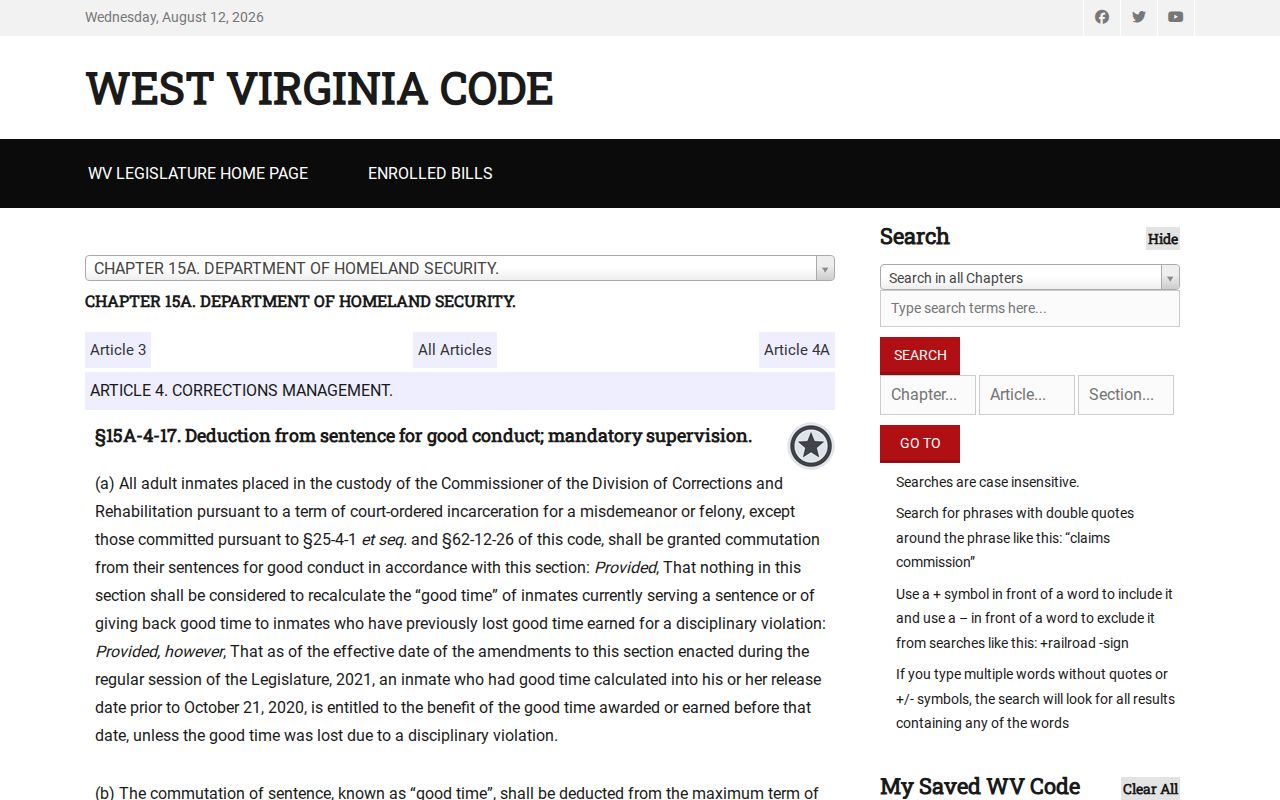
The source also sets limits. No good time accrues while a person is on parole, bond, or another non-incarcerated status. A life-sentenced inmate receives none. Discipline can lead to forfeiture, and later action can restore credit. WVDCR must give the inmate a statement of the sentence and computed minimum discharge, then issue a revision when forfeiture or restoration changes the earliest date.
| Credit or rule | Effect on the calculation |
|---|---|
| Eligible incarcerated day | Generally earns one day of good time. |
| Credited presentence jail time | Can earn good time when it qualifies and the court has credited it. |
| Parole, bond, or other non-custody time | Does not earn incarceration good time. |
| Life sentence | Receives no good time under the statute. |
| Consecutive eligible sentences | Are combined for the sentence calculation. |
No General West Virginia 85% Rule
West Virginia research did not verify a general rule requiring every state prisoner to serve 85 percent of the sentence. That claim is often borrowed from other jurisdictions, including the neighboring Commonwealth of Virginia. It should not be applied to a WVDCR date. The West Virginia calculation instead depends on the sentence, jail credit, statutory good time, excluded classes, discipline, supervision provisions, and later legal changes.
Day-for-day credit also does not mean that every eligible person will leave after exactly half of the announced sentence. The credited start date can differ from the arrest date. Some time may not qualify. Consecutive terms are combined. Good time can be lost or restored. An amended order, new sentence, or detainer can alter the path even when the minimum calculation remains correct.
Does a simple calculator give the date? No. A date calculated from sentence length alone can miss the controlling judgment, credited days, excluded status, or an updated WVDCR time sheet. The newest agency calculation and court orders should control the check.
West Virginia Additional Release Credit
The commissioner may award added good time for meritorious service or extra emergency duties. An eligible felony inmate can also receive up to 90 days for each approved optional academic or vocational program that is not required by the person's individualized reentry plan. Policy 151.06 calls for an updated time sheet and a revised OIS minimum-discharge or final-release date when qualifying additions change the computation.
These credits are not safe to assume from a program name or from an old date. The program must qualify under the governing rule, the award must be entered, and the current sentence computation must reflect it. A screenshot saved before the update can become stale. The proper record is the latest time sheet or current portal label, read with its retrieval date.
Forfeiture works in the other direction. A disciplinary action can remove accumulated good time, while later restoration can return some or all of it. WVDCR must revise the computed date when either action changes the earliest release point. That is why two accurate records created on different days can show different projected dates.
Note: Optional program credit and meritorious credit affect a date only after WVDCR awards and enters them in the sentence calculation.
Why West Virginia Release Dates Change
A projected date is built from legal and custody facts that can change. The newest DCR time sheet should be compared with the judgment, amended orders, and any active detainer. Do not silently choose the earliest date when sources conflict. Keep each label and ask which record documents the completed movement.
| Change | Possible effect | Best check |
|---|---|---|
| Good-time forfeiture or restoration | Moves the computed minimum date later or earlier. | Revised WVDCR time sheet |
| Added approved credit | Can reduce the remaining institutional term. | Current OIS date and time sheet |
| New or amended court order | Can change the sentence, credit, or authority for release. | Signed circuit or magistrate order |
| Consecutive sentence | Can extend the combined computation. | Judgment and WVDCR calculation |
| Detainer or hold | Can change the destination without ending other custody. | Sending and receiving agencies |
| Parole decision | Can create a conditional release path but not an instant gate date. | Board record and WVDCR processing |
Policy 151.06 also identifies statuses that need more legal context, including sanctions tied to parole, mandatory supervision, probation, home confinement, drug court, civil contempt, bond revocation, federal sentences, fugitive periods, and interstate cases. A generic date calculator cannot resolve those categories.
West Virginia Release Starts Supervision
Good time can shift part of a correctional term from a secure institution to monitored release. For specified violent, firearm, and minor-victim felonies committed on or after July 1, 2013, §15A-4-17(k) deducts one year from accumulated good time to create one year of mandatory post-release supervision. The supervision includes electronic or GPS monitoring. Institutional exit and the end of correctional control are therefore not the same day.
For other felony sentences, subsection (l) permits the sentencing court to order up to 180 days, or a shorter part, as mandatory post-release supervision. Section 15A-4-17a creates a separate conditional supervised-release plan for the final 180 days for an otherwise eligible person who was not granted discretionary parole. A violation can return the person to custody, and that supervision ends at minimum expiration.
This distinction changes how a date should be described. “Projected prison release” may mark the expected move out of the institution. “Maximum parole discharge” or final discharge can occur later. Search and record notes should name both stages when both apply.
West Virginia Court Release Dates
The sentencing court supplies the legal base for the WVDCR calculation. West Virginia uses two statewide trial-court portals. WVPASS covers circuit cases in all 55 counties, while the Magistrate Case Record Search covers magistrate matters statewide. A felony sentence may sit in circuit court even when an earlier bond or preliminary event appears in magistrate court.
The official Court Record Access page shows both statewide routes.
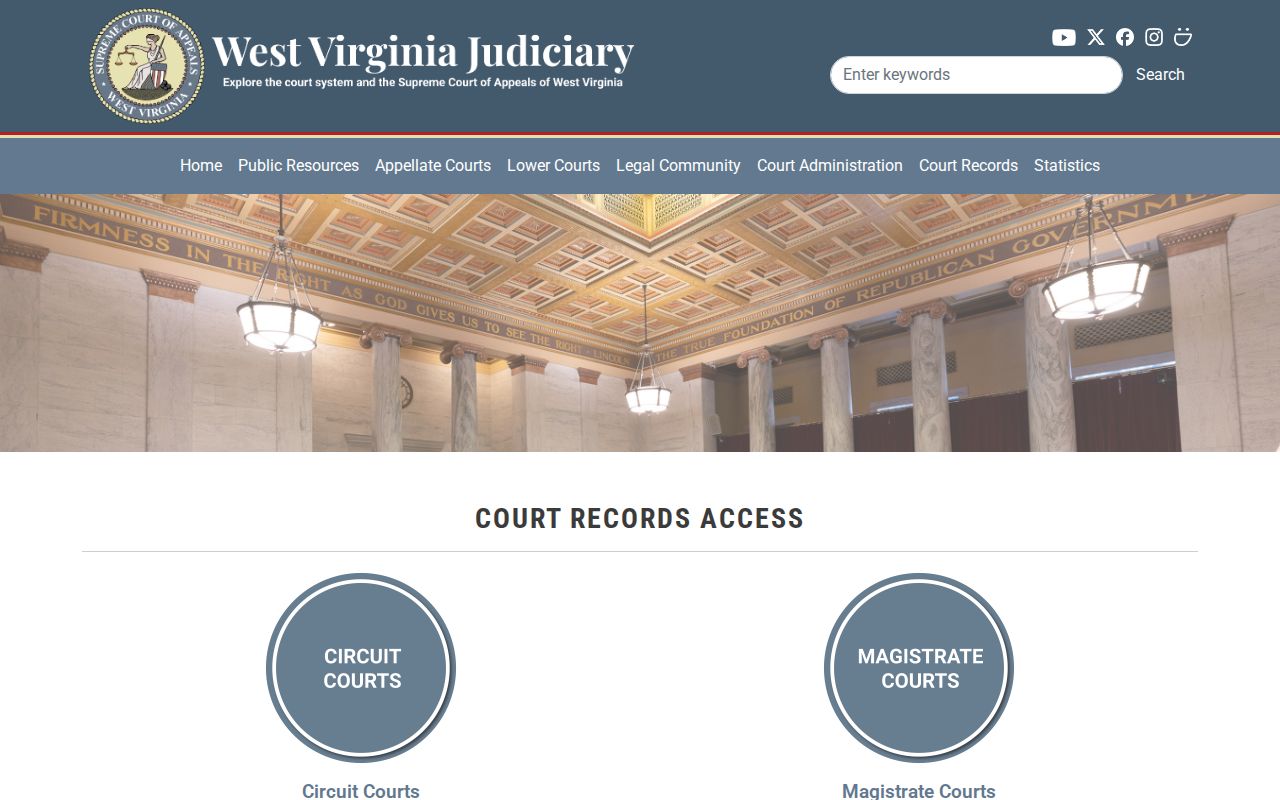
Neither court portal is a real-time custody registry. Court records can explain the sentence, credit, bond, dismissal, amended order, probation, or revocation that changed a projected release date. WVDCR confirms the custody calculation and movement. Together, the two records answer more than either one alone.
A regional-jail detainee who has not been sentenced needs this court path most. The case may show a bond or release order while the jail system still processes the movement. The signed order time and physical release time may differ.
Note: A court order may authorize release before the jail completes processing, so preserve both the order date and the actual movement time.
Confirm a West Virginia Release
After the projected day arrives, confirm the event rather than assuming it occurred. Check WVDCR for an updated location or active supervision clue. Review VINE for a custody-status event. Compare the court order. If the person moved to parole, use the proper Parole Services office. If a detainer points to BOP, ICE, another state, or another jail, continue with the receiving custodian.
West Virginia VINE covers all ten regional jails and WVDCR prisons, but it is an event-notification system rather than a permanent historical archive. Register before the expected movement when an alert is needed. The statewide VINELink Check explains the West Virginia search and notification path.
- Save the projected label and its retrieval date before the expected release.
- Check for a later WVDCR date or location change.
- Match the event to the court, parole, or detainer record.
- Request the final release or movement record if the public sources conflict.
A final record request can seek the existing actual release date and type, release order, public final time sheet, transfer indicator, and discharge record if one exists. Ask for electronic copies and segregable nonexempt parts. That request seeks recorded facts; it does not ask WVDCR to predict or calculate a new date.
Record the date each source was checked. A later time sheet or amended order should not silently replace the older value; keeping both makes the reason for a changed West Virginia projected release date easier to verify.